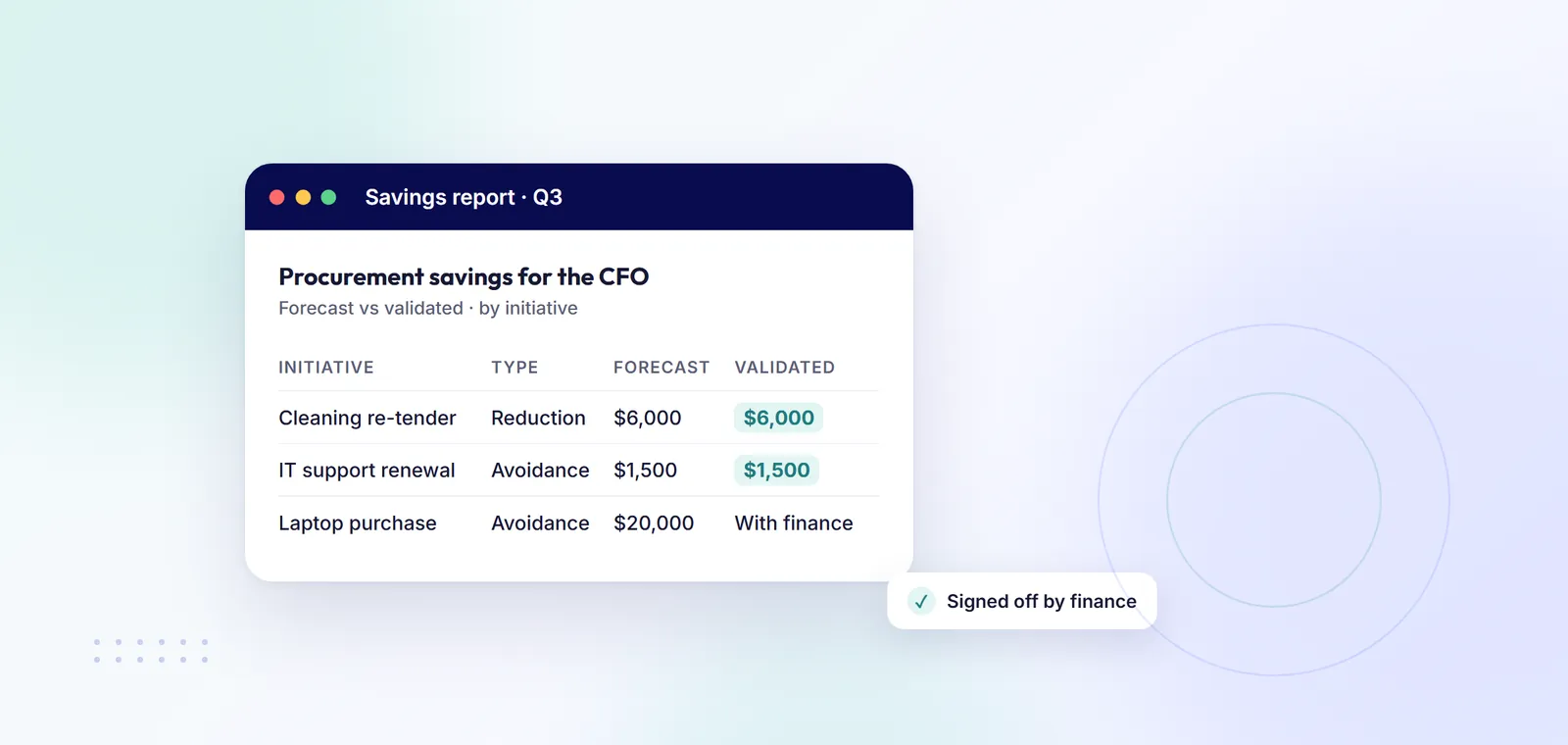
To report procurement savings your CFO will trust, agree the savings definitions and baseline methods with finance before you claim anything. Then record every initiative with an owner, a baseline, a forecast and a start date. Have finance validate each saving before it counts, and report forecast and realised savings separately, split by type: cost reduction, cost avoidance and process savings. A spreadsheet works for a handful of savings, and oboloo does the same job on a free-forever plan, with finance validation included.
Savings go straight to profit. At a 10% profit margin, a $100,000 saving adds as much profit as $1 million of extra sales.
The trouble is trust. Procurement says it saved $250,000, but the CFO cannot find it in the accounts. Often the saving was real, but it was measured against a baseline finance never agreed, reported cost avoidance as a cut, or was counted before the contract started. The method below fixes that.
The numbers below are made up to show the layout.
| Initiative | Supplier | Type | Baseline | Forecast (12 months) | Validated | Realised to date | Owner |
|---|---|---|---|---|---|---|---|
| Cleaning contract retender | Supplier A | Cost reduction | Last price paid: $120,000 a year | $18,000 | Yes (finance, March) | $9,000 (6 of 12 months) | Facilities manager |
| Software renewal, price rise refused | Supplier B | Cost avoidance | Proposed 7% rise on $50,000 | $3,500 | Yes (finance, April) | $1,750 (6 of 12 months) | IT manager |
| New packaging supplier | Supplier C | Cost reduction | Average of 4 compliant quotes: $46,000 | $5,000 | Pending | $0 (contract starts July) | Operations buyer |
| Quote rules for low-value buys | Internal | Process saving | 10 hours a month | 120 hours | Yes (procurement) | 60 hours | Procurement lead |
Totals by type: cost reduction $23,000 forecast, $18,000 validated, $9,000 realised. Cost avoidance $3,500 forecast and validated, $1,750 realised. Process savings 60 hours so far, reported apart from cash.
The CFO can see what finance has signed off, what has started to land, and what is still a forecast. The packaging saving is not realised yet, because that contract has not started.
oboloo is free-forever procurement software for SMEs and charities. Its savings tracking lets you create unlimited savings initiatives on the free plan. You can track cost avoidance, such as stopping a price rise, hard savings from negotiating a lower price, and process savings from reducing hours. The baseline, assumptions, timing and owner are recorded upfront. Validation can be done by procurement, finance or both, and only validated savings make it into reports. Savings move to realised when milestones are hit, and dashboards separate pipeline, projected and validated savings. You can report by project, team, supplier and timeline.
Validation is in the free plan. Savings Plus, at $20 per user a month billed annually, adds savings approvals, unlimited savings milestones, savings document attachments and custom fields, with a 14-day free trial. Other tools are compared in our guide to savings tracking software for mid-sized companies.
Subtract the new price from the baseline price and multiply by the volume you expect to buy over an agreed period, usually 12 months. A $120,000 a year contract retendered at $102,000 saves $18,000 a year.
The price you measure a saving against: usually the last price paid, the average of compliant quotes, a budget or should-cost estimate, or a market index. Agree the method with finance before you negotiate.
Track them monthly inside procurement and report to the CFO quarterly, or monthly if finance reforecasts monthly, so your numbers match theirs.
A forecast saving is what you expect a deal to deliver, worked out when you award it. A realised saving is what has actually been delivered so far, at the new price and the volume you actually bought.
Finance, or procurement and finance together. The person who negotiated the deal should not be the only one to sign it off.