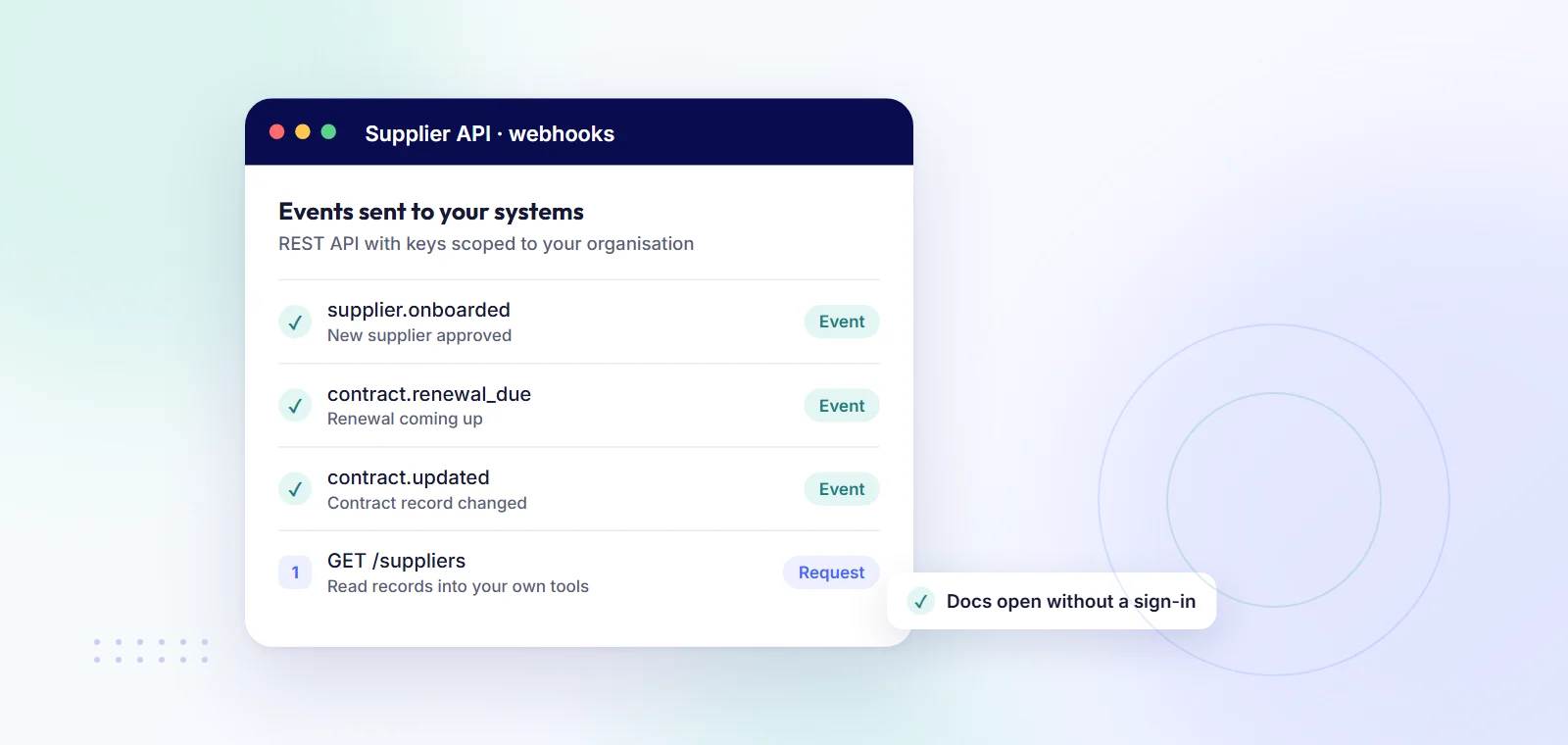
oboloo has an open REST API that reads and writes suppliers, contracts, sourcing, savings and users, with webhooks such as supplier.onboarded and contract.renewal_due, and API keys scoped to your organisation's permissions. API access comes with any Plus plan, while the Zapier connection and the MCP connector for AI assistants are on the free plan. Gatekeeper also offers a REST API and webhooks for vendor and contract records, on quote-only plans. ContractSafe has an API on its top plan, and Precoro and Procurify publish APIs but are purchasing tools built around purchase orders and invoices. For most small businesses the order is: no-code first, an API when a developer is available, and an MCP connector when you want to ask an AI assistant about your suppliers.
Full disclosure: oboloo is our product. We read each vendor's own pricing pages and developer or help pages on 12 November 2026.
An open API is a documented way for other software to talk to yours. For a buyer, it usually means three things:
Supplier management (also called vendor management) is a good fit for an API because the supplier list is needed elsewhere: in your accounting package, your CRM, a shared spreadsheet or an internal report. See our supplier management system for what the records hold.
oboloo is free-forever procurement software for SMEs and charities: supplier management, contract management, sourcing (RFQs, RFPs and RFIs) and savings tracking, with unlimited users. The API uses bearer tokens from API keys scoped to your organisation's permissions, and sends webhook events such as contract.updated, supplier.onboarded, saving.created and contract.renewal_due. The developer documentation is public: your developer can read it at oboloo.app/api/documentation without signing in.
Where it fits less well: API access is not on the free plan, so a free user automates through Zapier or MCP. oboloo does not do purchase orders or invoices.
Gatekeeper is vendor and contract management software. Its pricing page lists API access as included on all three plans, with no prices published. Its help centre lists webhooks for vendor, contract and spend events, set up in the app. The API documentation sits inside each customer's own Gatekeeper account rather than on a public page.
ContractSafe is contract management software. Pricing starts at $450 a month billed annually. Zapier is on the Finalize plan, and the API only on Maximize. We found no published webhook documentation. It covers contracts, not supplier records or sourcing.
Both are purchasing tools. Precoro has webhooks (up to 5 endpoints) and public API documentation, with API access from the Automation plan. Procurify has a REST API with public documentation and an OpenAPI file, included on every plan, and its help centre says it does not support webhooks. If you need purchase orders and invoice approval with an API, these are built for that; oboloo is not.
A documented set of REST endpoints that lets other software read and write supplier records, usually with API keys for access and webhooks to announce changes.
Yes. The oboloo REST API reads and writes suppliers, contracts, sourcing, savings and users, and sends webhooks such as supplier.onboarded and contract.renewal_due. API access is on any Plus plan.
Yes, through Zapier. oboloo's Zapier app is on the free plan and can create or update suppliers and contracts from other apps.
Rarely. oboloo's free plan includes Zapier and the MCP connector but not the API. None of the other four tools we checked lists a free plan on its pricing page.
An API is for software built by a developer. An MCP connector lets an AI assistant such as Claude or ChatGPT read your records when you ask it a question, with no code and no API keys.