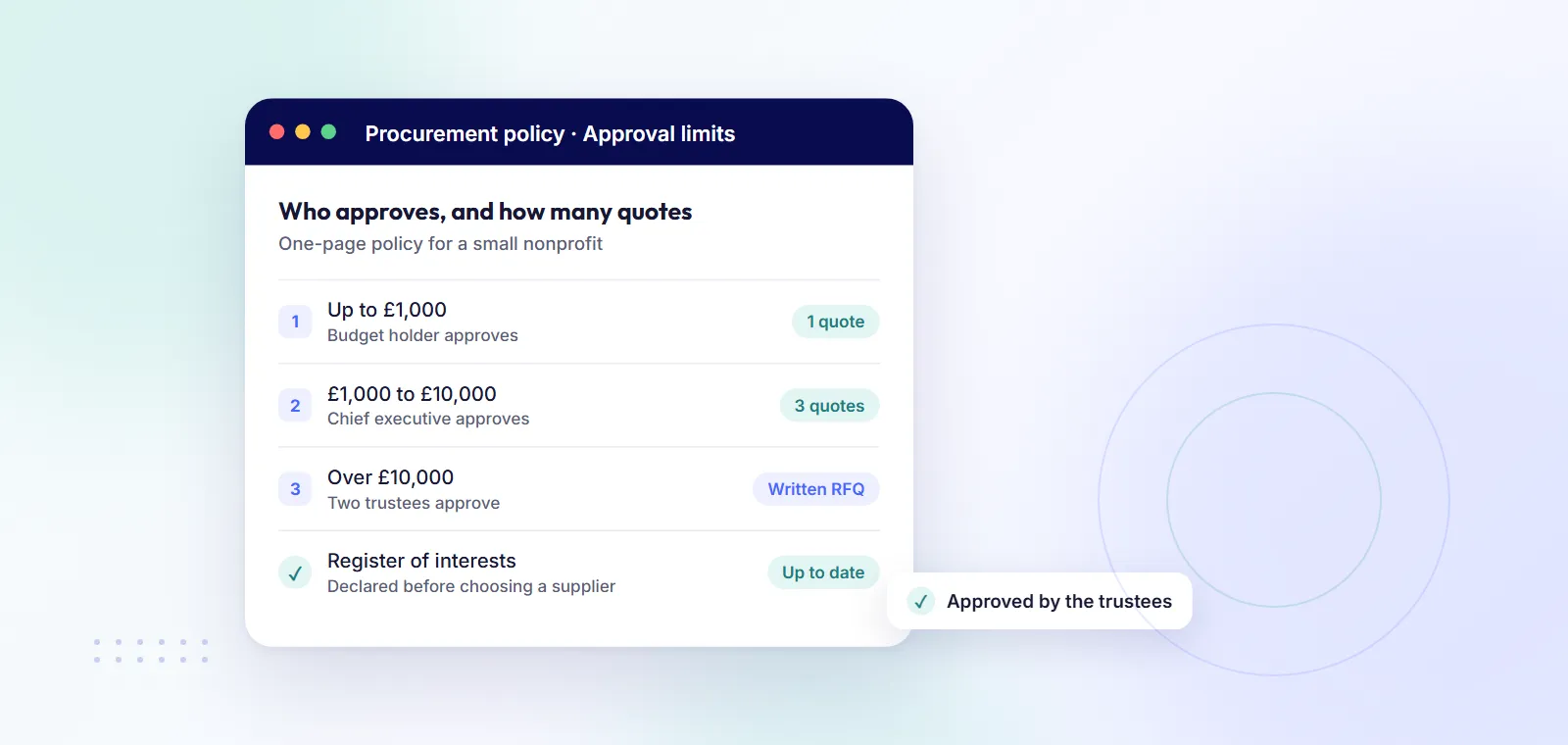
Yes. A small nonprofit or charity can use a one-page procurement policy that covers six things: who can approve spending, when you need quotes, how suppliers are chosen, how conflicts of interest are handled, who signs contracts, and what records you keep. Below is a template you can copy and fill in. If you spend US federal grant money, there are a few extra lines you must add, and we list them. oboloo also has a free procurement policy generator that builds a first draft from your own approval limits.
A procurement policy is not paperwork for its own sake. It answers the questions a trustee, auditor or funder will ask: who decided to spend this money, did they compare prices, and did anyone involved have a connection to the supplier?
In England and Wales, the Charity Commission's guidance on internal financial controls (CC8) asks charities to have "clear, written authority limits" for placing orders and approving payments, to involve more than one person in each transaction, and to keep a register of interests. A short procurement policy is the simplest way to show those controls exist.
In the US, a nonprofit buying goods or services under a federal award "must maintain and use documented procedures" for procurement (2 CFR 200.318). The policy below is a starting point for those procedures.
For the longer argument, see why have a procurement policy.
Copy the text below into a document. Replace everything in square brackets. The amounts are examples only: set limits that suit your size and your funders' rules.
1. Purpose
This policy makes sure we spend money with suppliers fairly, get good value, and can show how each decision was made.
2. Scope
It covers all purchases of goods, services and works paid for by [organisation name], from any fund, including restricted and grant funds. It does not cover staff pay or grants we make to others.
3. Who can approve spending
No one approves a purchase they asked for. Do not split a purchase into smaller orders to stay under a limit.
4. Quotes
If we take fewer quotes than this policy asks for, the approver writes down why.
5. Choosing suppliers
We choose on value for money, not price alone. Criteria may include quality, delivery, experience with organisations like ours, and [environmental or social criteria that matter to us]. New suppliers are checked before first use: [insurance, references, safeguarding or data protection where relevant].
6. Conflicts of interest
Anyone with a personal or family interest in a supplier must declare it and take no part in choosing, approving or managing that supplier. We keep a register of interests for trustees and staff who buy or approve. We do not accept gifts or hospitality from suppliers above [£25 / $25].
7. Contracts
Contracts over [£5,000 / $5,000] a year, or longer than [12 months], are signed by [the chief executive or a trustee]. For each contract we record the end date, notice period and owner, and review it before the notice period closes.
8. Urgent purchases
In a genuine emergency, the [chief executive] may approve a purchase without quotes. The reason is recorded and reported to [trustees] at the next meeting.
9. Records
For each purchase over [£1,000 / $1,000] we keep the quotes, the reason for the choice, the approval and the contract. We keep records for [six] years.
10. Review
[Trustees or the board] review this policy every [year].
Approved by [name], [date].
The template covers the basics. If any purchase is paid for under a federal award, the Uniform Guidance asks for more. Check each point with your funder, because thresholds change:
Most small nonprofits do not break their policy on purpose. They break it because getting three quotes by email takes a week, nobody remembers the notice date, and the record of why a supplier won sits in someone's inbox.
Three habits help:
You can do this with spreadsheets. Our free procurement policy template and RFQ comparison template give you the columns. Or you can use free-forever procurement software: oboloo covers supplier management, contract management, sourcing (RFQs) and savings tracking with unlimited users, and keeps an audit trail of every sourcing event. Registered charities and non-profits get 50% off paid plans, forever (oboloo for charities).
Where it fits less well: oboloo does not raise purchase orders, approve invoices or make payments. Section 3 of your policy (who approves spending) still runs through your accounting system or a purchasing tool. We compare both kinds in procurement software for charities and nonprofits.
Who can approve spending and up to what amount, when quotes are needed, how suppliers are chosen, how conflicts of interest are declared, who signs contracts, what to do in an emergency, and what records to keep.
It is not a legal requirement for every UK charity, but CC8 expects written authority limits and a register of interests, and a short procurement policy is the easiest way to show both. Funders often ask for one.
Set your own rule, for example three written quotes above a set amount. Under the Uniform Guidance, purchases above the micro-purchase threshold need quotes from an adequate number of qualified sources.
Yes. Copy the template above, or use oboloo's free procurement policy generator to build a first draft from your own limits. Neither is legal advice, so have your trustees or board approve the final version.
The policy sets the rules, such as limits and quote numbers. Procedures describe the steps staff follow to meet them. A small nonprofit can keep both on one page. See procurement policy vs procurement procedures.