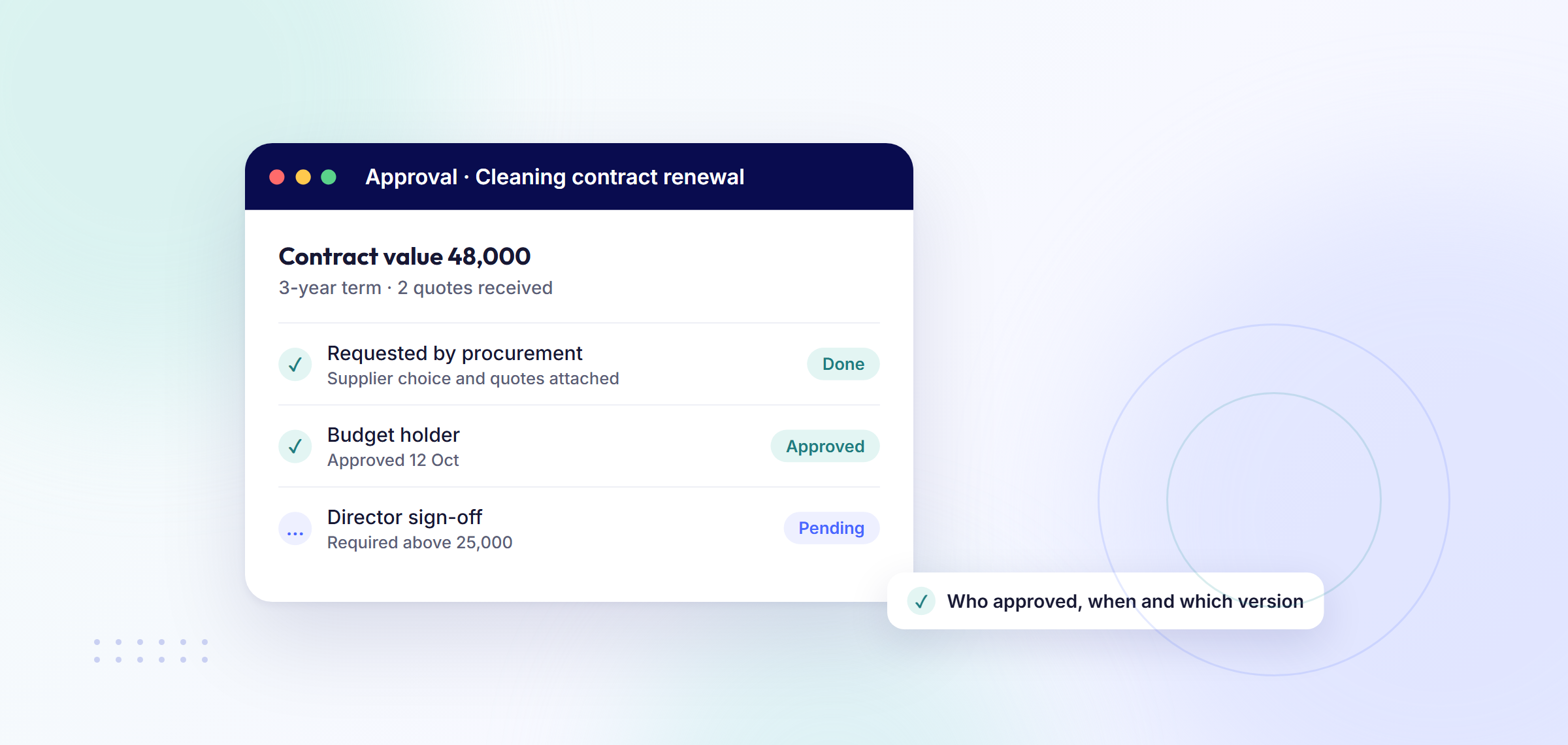
Write one short approval matrix: three or four contract value bands and, for each band, how many quotes you need, who approves the supplier choice and who signs. A workable small-company version is one quote and the budget owner's approval at the low end, three written quotes and a manager's approval in the middle, and a formal RFP with director approval at the top. Two rules hold it together: the person who picked the supplier is never the only approver, and every approval is recorded with the date and the version approved. Email and a spreadsheet are enough while volumes are low. After that, use software that keeps procurement approval workflows on the contract record, such as oboloo (contract approvals are in Contract Plus, at $10 per user a month).
Full disclosure: oboloo is our product. The thresholds below are an example, not a legal or audit standard.
Use the total value over the contract's full term, including expected extensions, not the annual value. Otherwise a three-year contract slips under a threshold it should have hit.
Example only. Adapt the bands, roles and currency to your organisation.
| Total contract value | Quotes or tender | Who approves the supplier choice | Who signs the contract |
|---|---|---|---|
| Under 5,000 | 1 quote, with a check that the price is fair | Budget owner | Budget owner, if named as a signatory |
| 5,000 to 25,000 | 3 written quotes | Budget owner and department head | Department head |
| 25,000 to 100,000 | 3 to 5 quotes through a structured RFQ, scored against set criteria | Department head plus procurement or finance | Finance director or managing director |
| Over 100,000 | Formal RFP or tender, scored by a small panel | Managing director, on the panel's recommendation | Managing director (or the board, if your rules say so) |
If you cannot get the quotes the table asks for, for example because only one supplier can do the job, the requester writes a short reason and the next level up approves it. If you run RFQs often, free RFQ software keeps the quotes, scores and decision together.
The person who chose the supplier should not be the only one approving that choice. In a team of five, the owner approves what the office manager picks, and the other way round. That protects the person who chose, too.
Record the approver's name, the date and the exact version they saw. "Approved in principle" on an early draft is not approval of the signed version.
Name a deputy for every approver and agree a time limit, say three working days, after which the deputy can approve. Otherwise one holiday stops every contract.
If approving a 3,000 contract takes two weeks, people will sign first and ask later. Keep the bands few and the bottom band quick. A short policy people follow beats a long one they work around.
Email and a spreadsheet can work if you sign a handful of supplier contracts a year and one person keeps the log current. The weak points show as you grow: approvals sit in personal inboxes, it is hard to prove which version was approved, and the log goes stale when its owner is busy or leaves. At audit time, someone spends a day searching old emails.
Software keeps the approval on the contract record, next to the documents and dates. It makes sense once you have more than one approver, more than a few dozen live contracts, or an auditor or funder who wants to see the trail. Our guide to managing supplier contracts in a small business covers what else to look for.
oboloo is free-forever procurement software for SMEs and charities. The free plan includes all four core modules (sourcing, supplier management, contracts and savings) with unlimited users, no card and no expiry. Its contract management software keeps signed agreements, drafts and amendments in one repository. For approvals:
Each contract links to its supplier, sourcing activity and savings. Plus plans have a 14-day free trial, and registered charities, non-profits and CICs get 50% off paid plans, forever.
Where it fits less well: oboloo does not draft or redline contracts. You agree the wording elsewhere and keep each version on the contract record.
A contract value above which a decision needs a more senior approver, more quotes, or both. For example: over 25,000 needs three quotes and director approval.
Your own policy sets this. A simple pattern is one quote for low-value contracts, three written quotes in the middle, and a formal RFP or tender above that. If you spend grant or public money, check the funder's rules first.
Someone your policy names as a signatory for that value, usually a director for larger contracts. Make sure they sign the same version that was approved.
Splitting a decision so no one person controls it from start to finish. The person who runs the RFQ and recommends a supplier is not the only one who approves the award.
Record who approved, the date, the version and the evidence behind it, such as quotes or scores, and keep it with the contract. In oboloo, Contract Plus records each contract approval on the contract record with who approved, when and which version.