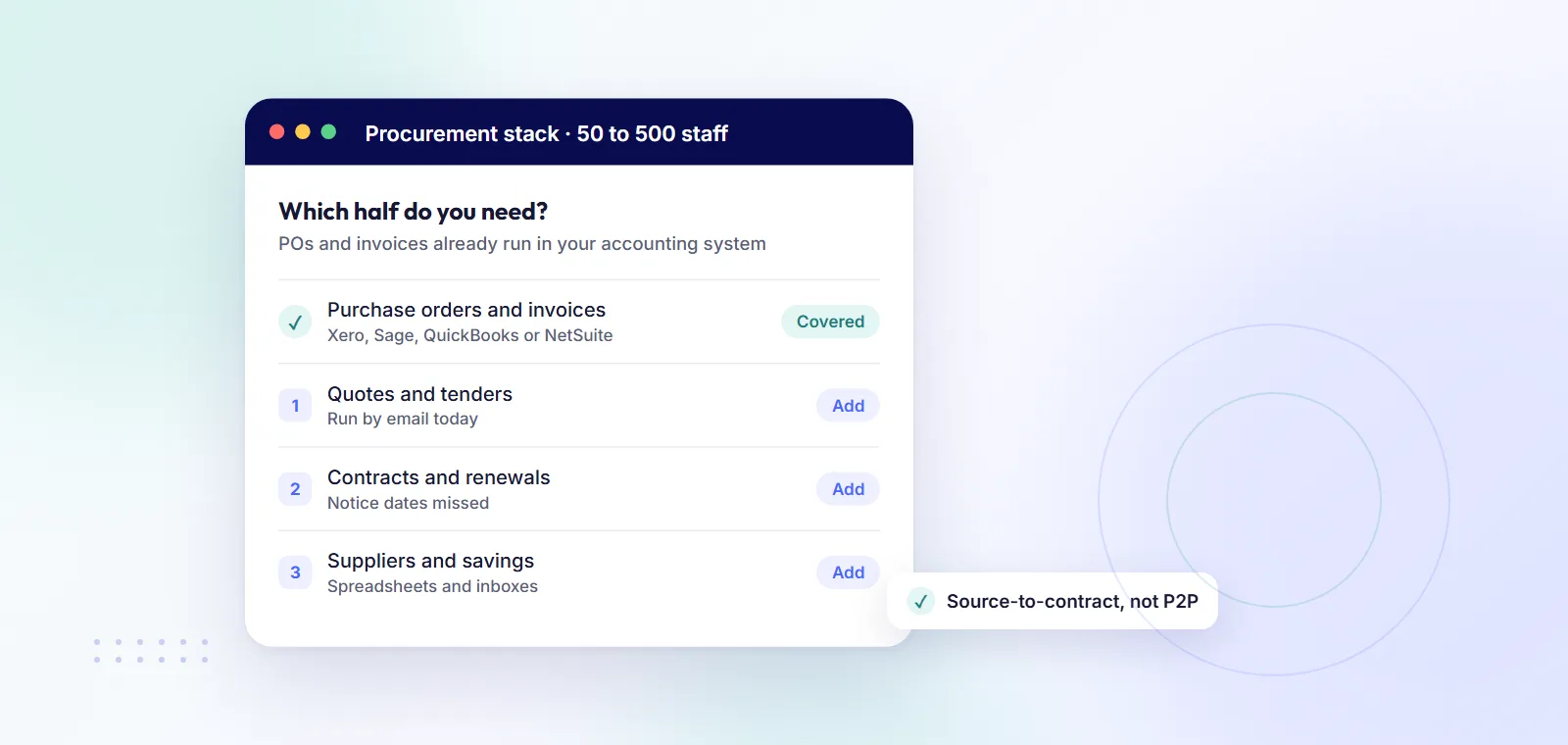
If your company has 50 to 500 staff and already raises purchase orders and pays invoices in Xero, Sage, QuickBooks or NetSuite, you probably do not need procure-to-pay (P2P) software. What you need is source-to-contract software: a tool for running quotes and tenders, keeping one supplier record, tracking contracts and their notice dates, and proving savings. oboloo does all four on a free-forever plan with unlimited users. Market Dojo is strong on eSourcing and eAuctions, Gatekeeper on contracts and vendor risk, and Prokuria on sourcing plus purchasing in one platform.
Procurement software splits into two halves.
A company of 50 to 500 people often has the first half covered already. Finance raises POs and pays invoices in the accounting system, and it works. The gaps are earlier: quotes chased by email, supplier certificates in someone's inbox, contracts renewing because nobody saw the notice date, and savings nobody can prove.
Adding a P2P tool on top of an accounting system that already does POs gives you two places for the same purchase. Adding source-to-contract software fills the gap without touching how finance pays. For more on the split, see source-to-pay vs procure-to-pay.
If your main problem is staff buying without approval, or invoices that do not match orders, that is a P2P problem. Our cloud procurement software for mid-sized companies guide compares the P2P tools as well.
Prices checked on each vendor's own site on 5 November 2026.
oboloo is free-forever procurement software for SMEs and charities. The free plan includes sourcing (RFQs, RFPs and RFIs), supplier management, contract management and savings tracking, with unlimited users, no card and no expiry. Suppliers answer your events through a link without creating an account, and you compare responses side by side. Contracts carry alerts before renewals, expiries or notice windows close. Only validated savings reach reports.
For a company moving off spreadsheets, suppliers and contracts can be imported from a CSV file. oboloo connects to 8,000+ apps through Zapier and has an API and an MCP server.
Optional Plus plans are per user a month, billed annually, with a 14-day free trial: Contract Plus $10, Savings Plus $20, eSourcing Plus $25 (weighted scoring, reusable templates) and Supplier Plus $28 (scorecards, onboarding, compliance). Unlimited users on the free plan means you can give every budget holder access without a seat count.
Where it fits less well: oboloo does not do purchase requests, purchase orders, invoices or payments. It sits alongside your accounting system, not in place of it.
Market Dojo is an eSourcing tool with eAuctions. Simple Sourcing costs £500 a month billed annually, £1,000 billed monthly, or £1,000 per event. Pro Sourcing is £583 a month billed annually. Contract management is free for up to 10 contracts, and supplier management is free for up to 3 users. It suits a team that runs regular competitive events and wants auctions. See Market Dojo vs oboloo.
Gatekeeper is contract and vendor management software. Plans are priced by the number of third parties you manage (Pro up to 250, Enterprise up to 750) with unlimited users and unlimited contracts. Prices are not published; you book a demo. It suits a company whose main worry is contract risk and vendor compliance rather than running quotes.
Prokuria describes itself as "one no-code platform for sourcing, suppliers, and purchasing". It covers sourcing, supplier management, contracts and spend analysis, and it also does purchase requests and orders. Prices are not published: the estimator shows a monthly starting price after you enter a work email, and an implementation fee applies in most cases. Choose it if you want sourcing and purchasing in one tool and are ready to move POs out of your accounting system.
For a wider list, see our supplier management tools that are not P2P and cheaper alternatives to Coupa and SAP Ariba.
P2P software handles buying: requests, purchase orders, invoices and payment. Source-to-contract software handles choosing and managing suppliers: quotes and tenders, supplier records, contracts and savings.
Not always. If your accounting system already raises POs and pays invoices, source-to-contract software usually fills the bigger gap. P2P software makes sense when spending without approval or invoice mismatches are the main problem.
Yes. oboloo, Market Dojo and Gatekeeper do not do purchase orders. They work alongside your accounting system.
Yes. oboloo's free-forever plan has all four core modules and unlimited users, with no card and no expiry. Market Dojo has free tiers for up to 10 contracts and up to 3 supplier management users.
oboloo connects to 8,000+ apps through Zapier and has an API. It does not take over purchase orders or invoices, which stay in your accounting system.